Title here
Summary here
Summary: Plan attic paths, drill clean holes, and secure outdoor cabling without creating eyesores.
This section covers the wiring that leaves the electronics box and heads toward your lights, including any “dark” spans where you’re routing cable but don’t want LEDs. We’re assuming you already mapped out your start, middle, and end points back in Planning.
I started by deciding exactly where the electronics box would live on the wall. From there:
I later 3D‑printed a transition piece to clean up the ceiling hole. Nothing fancy, just something to hide my very human drywall skills. After that, the conduit slid through and was fully secured to the wall.
The cable quality has been great so far and the price makes it even better. My only gripe is the jacket. It’s a harder plastic than I’m used to and snaps cleanly along a scoring line, especially when cold. That’s great for stripping but makes me slightly paranoid about long‑term brittleness. I’d still buy it again (and have), but I’ll keep an eye on it over the next few seasons.
With the conduit in place, here’s the repeatable process I used:
Earlier I had already:
Once the wire was cut long enough to stick out about a foot from the soffit, I taped it to the fish (with a tail for easy removal) and pulled it through.
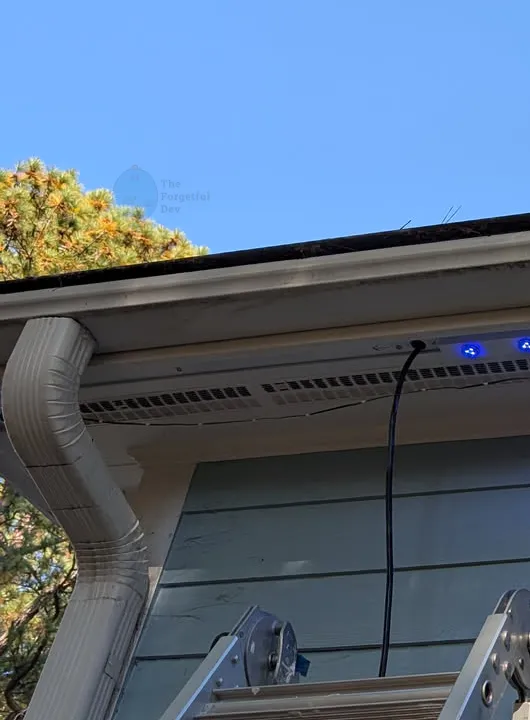
I installed the xConnect pigtail outside on the ladder – it’s much easier than carrying the necessary supplies to make a cable in to the attic. Then I repeated the whole process for the start of the second segment. After everything was in place, I added staples to keep the runs neat.
This follows the exact same playbook as the segment‑start wiring:
For the middle injection, I hardwired directly into the strip. You can absolutely use the included 3‑way adapters to keep things modular, but they bulk up the track a bit.
For the end injection, I used an xConnect pigtail and capped the data line since it isn’t needed there.
Anywhere I didn’t want LEDs — chimney bypasses, stacked roof peaks, etc. — I used 14 AWG 3‑wire as a dark span.
Just like before, all the track holes and wire fish lines were already in place. The process:
From there, I tried a few different methods to tie the cable back into the LED string.
14 AWG fits in red butt connectors if you keep the strands smooth. This is great when the LED strip already ends in an xConnect. I avoided it on freshly cut segments.
Use butt connectors from the 14 AWG straight to the puck wires. Fewer connectors, less bulk, but sacrifices flexibility later.
Not a real word, but it works. Connect cable to puck wires using inline Wagos. Best flexibility, but Wagos weren’t designed for outdoor use. They’re somewhat protected inside the track, but still use caution.
Hardwire the end of the light string to the start of the cable, then put an xConnect pigtail on the other end of that cable. Now one side is fixed, but the other is modular. That said, if the string already had an xConnect attached, I usually just used it.
