Title here
Summary here
Summary: Start on easy runs, align the rails, and keep notes before you add puck tracks.
I printed a simple jig to keep hole spacing consistent. You can eyeball it if you want, it doesn’t actually matter, but the jig made the whole process smoother and more “automatic” for me.

Holding your base track on the soffit with one hand while driving a screw with the other sounds doable, but it’s annoying at best, dangerous at worst, and will very likely be crooked. Not to mention I probably dropped 5% of all the screws I installed.
What worked for me:
It is an added step, but it makes getting the first screw in much easier. This anchors the section and keeps your alignment exactly where you want it without the screw wandering. It may not be that big of a deal in easy areas, but it will really help when you’re in hard-to-reach spots.
Leave all of the screws a little loose. Not wobbly, but not locked down either. This small bit of play does two things:
You will thank yourself later when installing the lights. There’s nothing more frustrating than thinking you’re in an easy spot, only to struggle and fight with the track because it won’t clip in.
Naturally you’ll want to keep your base tracks and your puck tracks perfectly aligned, meaning the two halves are the same lengths as each other and each one starts and ends in the same place. Of course for a full run you need them to start in the same spot and end in the same spot so you don’t have one running longer than the other, but for all the points in between… consider offsetting them.
If at the start of a run you intentionally cut one of the track halves a little shorter, you’ll now be able to use the puck track to bridge the gap between two base tracks. This “gap” should be small because you’re butting the base tracks together, but it’s still a gap.
By offsetting them and having your puck track snapped in to two separate base tracks, it helps align everything perfectly and makes it feel and look like one continuos unit.
I’ll say again: that’s a trick I didn’t figure out until the end and I wished I had done it sooner. It really makes your long runs more cohesive.
Once the first screw is in:
Full-length sections go fast once you get the rhythm. The hardest part will be figuring out what tools you want in what pocket. And make sure you always have more screws then you need… you will drop some (or a lot if you’re me). Having a good tool belt can be really helpful here.
You are obviously going to need to cut tracks shorter as you reach the ends of your soffits. It’s easy to do, but there are a few things that can make it way harder than it needs to be.
When we were installing full-length tracks you only work with the base track. When you start cutting the tracks down to size you need to work with the base and puck tracks together so that you have matching pieces when you go to install the lights.
Measure, then mark the cut point on your track.
Unless it’s necessary for your setup, I would cut things a little short just to give you some wiggle room with the install. It also leaves room to get an endcap snapped in to the track (if you’re using endcaps).
Cutting the base track and puck track separately often leads to mismatched lengths or a lot of extra work for no reason. Snap them together and cut both at once to make your life easier.
I typically cut mine with the face track either pointed up or pointed towards me. That reduced the risk of scratching the most visible part and also will hide “tear out” if you have any (although that’s very unlikely on aluminum).
If a burr points inward, it can nick the cable. File the interior-facing cut clean with just a couple swipes of a file; no need to go crazy. The outside-facing burrs don’t matter as much.
If you’re installing your tracks the same way I did then at this stage you’re only installing the base tracks, and you’ll come back later to do the actual lights and puck tracks. But that means you need a way to re-associate the two track halves later. You could just install the puck track now (without the lights) and then take it off again when you’re ready to install, but that’s a couple added steps. I found it easier to label them and then set the puck tracks aside for later.
Immediately after cutting the track, I labeled the inside of both halves using a marker. I originally started with letters, but as the track install went on for days and weeks, I would forget where I was.
I ended up switching to the date plus a letter. I ended up with something like:
12/08 A
12/08 B
12/10 A
12/11 A
12/11 B
12/11 C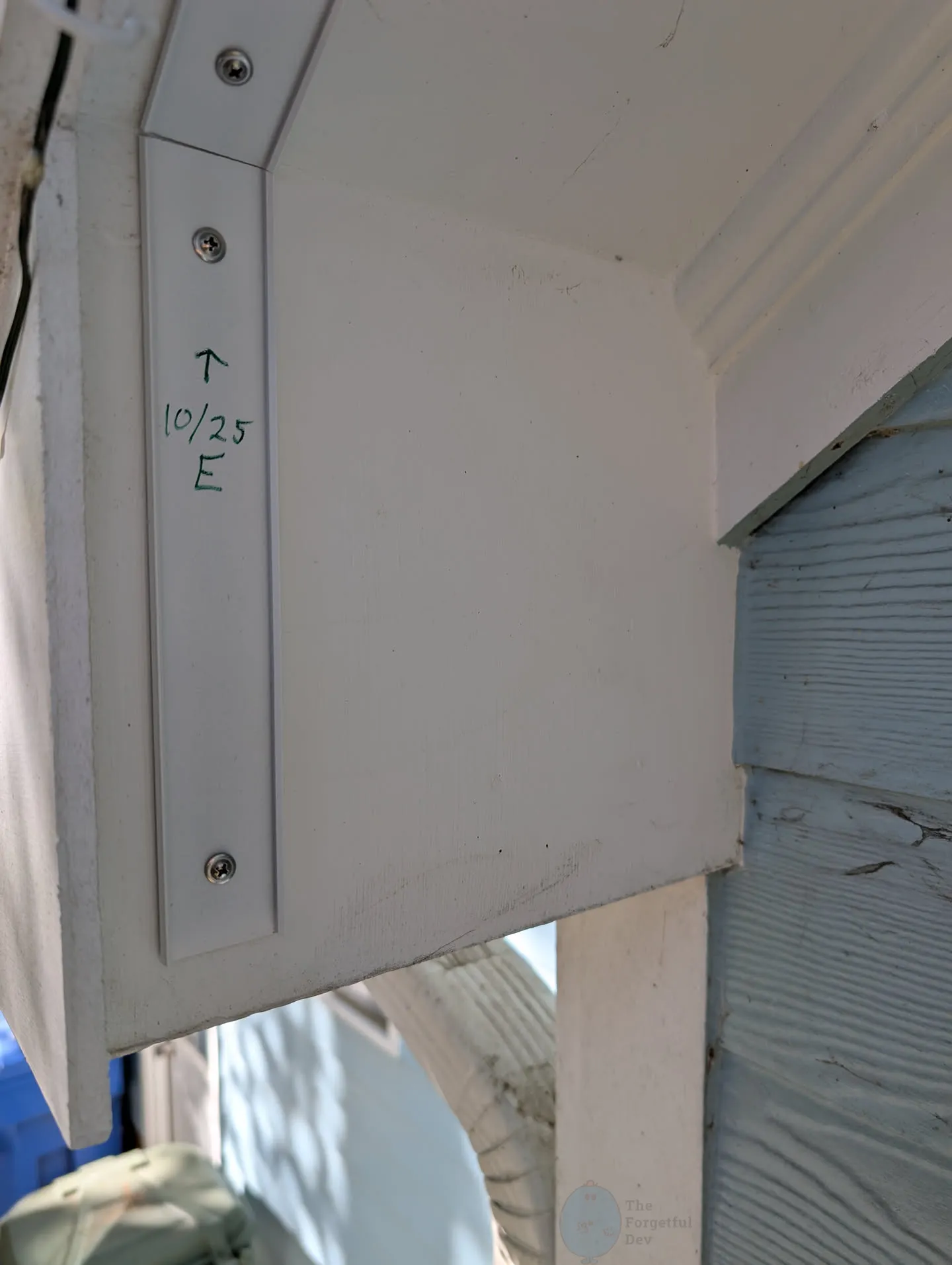
It made it trivial later to match each puck track to its correct base track. Whatever method you decide to use for labeling, just make sure you keep up with which ones belong together.
Short sections often only need two screws instead of the typical three. Other than that, the install process is the same as when installing a full-length track.
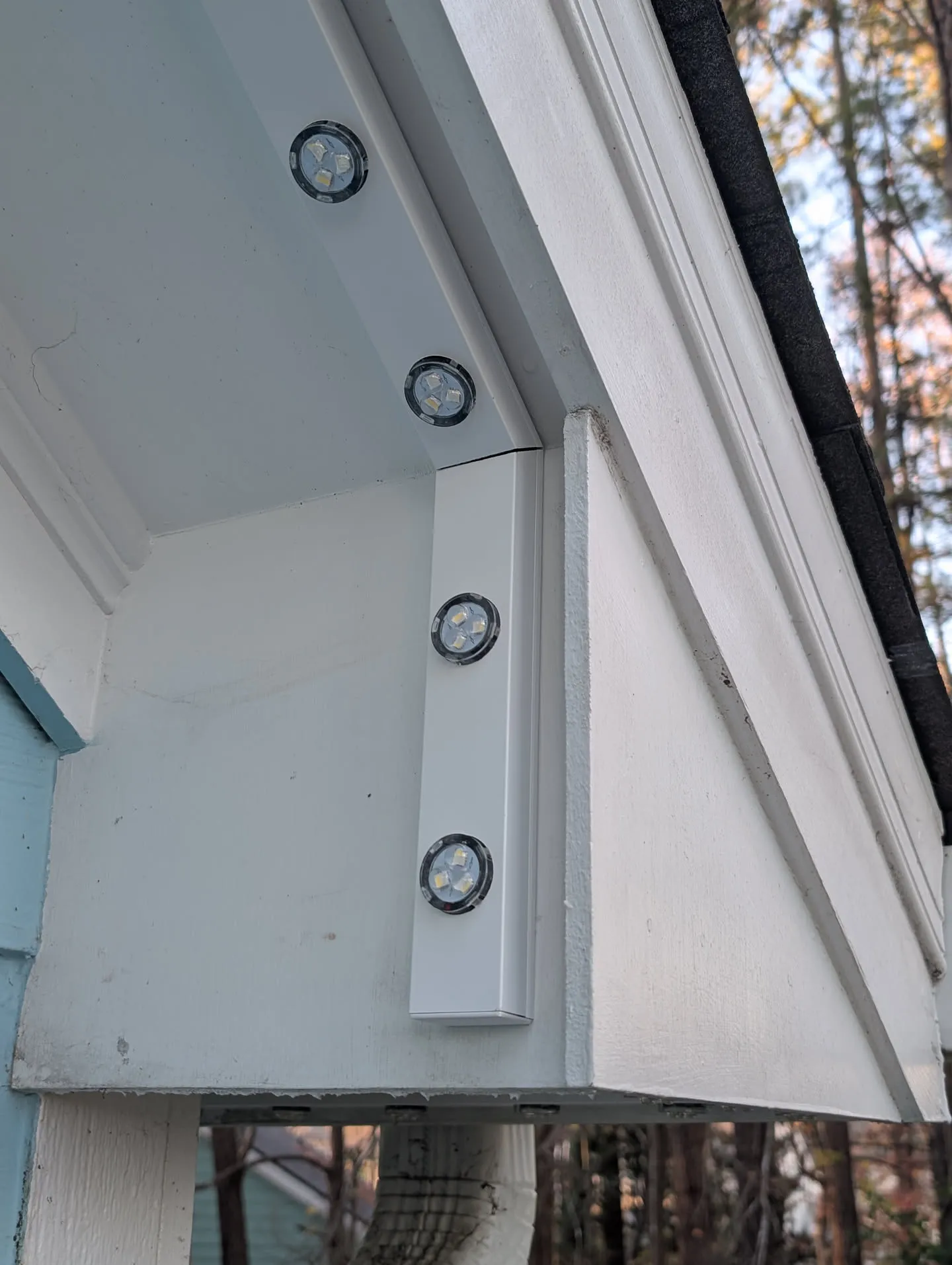
I didn’t do mitered corners for horizontal turns (more on that in the “Before You Install” section), but you will want to do bevel cuts for all the angles involved with a gable peak or any transition that is at an angle. A clean bevel helps the tracks follow the pitch and keeps things look smooth.
Bevel cuts follow the same principles as what was discussed in the regular custom length cuts discussed above, but there are added steps for how to measure and cut the angles.
Use an angle finder (digital is nice) to measure the angle of the peak that the track needs to transition across.
Technically you don’t need to measure this and you can just do the math if you know the roof pitch angle, but I found that the real-world angles on the soffits often didn’t match up exactly. Even opposite sides of the same gable didn’t always have the same angle. To me it’s better to just get an in-place measurement.
While here you also need to measure the necessary length for the track you’re cutting if a full-size one won’t fit. The measurement should be based on the base track length (which will end up being longer than the face track when we cut it).
Divide the measured angle in half and set your saw angle to that number. I always angle my saw left-to-right (see picture below).
For full-length tracks you can skip measuring and marking and go to the next step since the length of your piece doesn’t matter.
Your base and face tracks should be snapped together at this point. To ensure your track is the right length after you cut the bevel, the mark for where you’re cutting must be made on the base track. Assuming you do the bevel cut correctly, your base track ends up being longer than your face track. If you measure the length you need and mark it on the face track and cut there then your piece will be longer than you expect.
Make your cut, label both track halves, and install the base track.
Because your saw is already set to the correct angle, it’s typically best to cut the next section for the other side of the transition right now.
The two opposing pieces should form a perfect transition when aligned. If you find that you have gaps or anything like that, your saws angle calibration may be off. You can fix it, or remember you need to add or remove some degrees to whatever you measured.
Since the puck openings dictate where cuts can be made, miters around corners were not practical for me. It would have been way too much extra work, and it would have resulted in the puck spacing being off somewhere. I chose to use butt joints instead, and I’m glad I did. But I already talked about this in several other places.


